Thursday, May 2, 2013
Review: Star Trek IV: The Voyage Home (1986)
What starts off on a stronger push towards a well-defined universe, with grit and a portrayal of Starfleet run by competent people again, ends more in less in a diversionary area where the Crew (and us?) gets to have some fun for a bit. That is Good or Horrible, depending who you ask... You're asking me? Oh. Uh.
We are still firmly in "The Adventures of..." territory, but at the very least I find myself admiring how strong the continuity is between these films. Months after the previous adventure, Spock is still acting a little weird from his sabbatacle from life and trying to re-educate his brain, the crew is in exhile on Vulcan and still piloting that Klingon vessel from the last film, and the Klingons are still pretty pissed off at all that shit that happened regarding Genesis and appealing to Starfleet to get them all incarcerated. Which isn't really all that unreasonable a request.
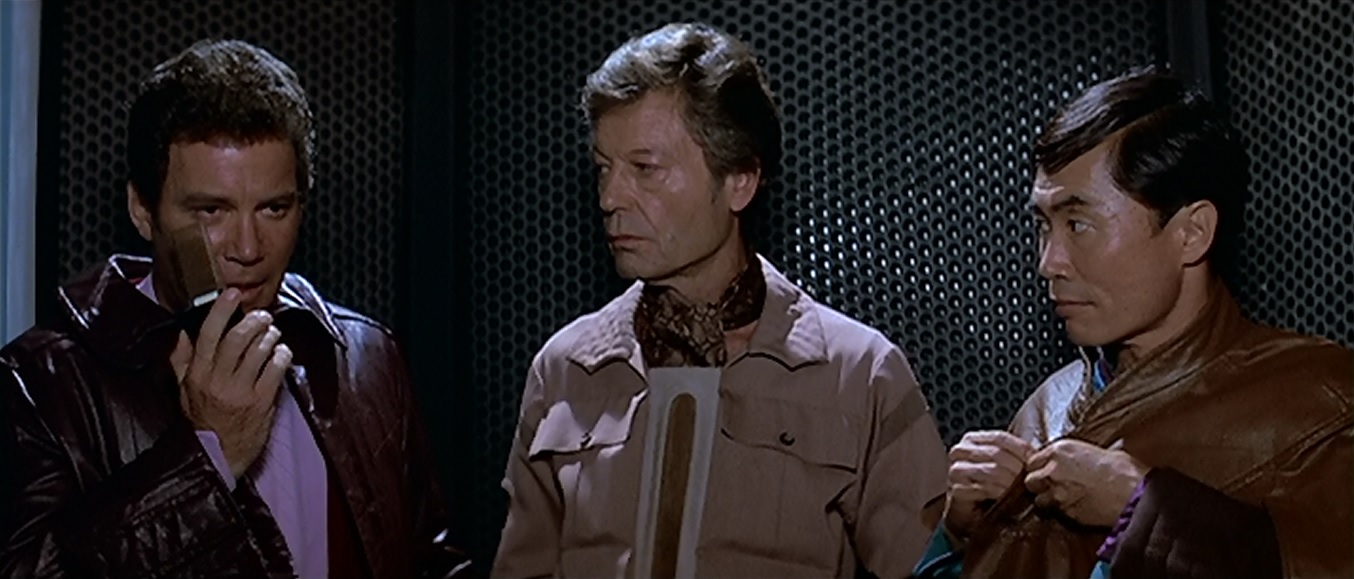
As the crew heads back to Earth to take part in their punishment, a strange vessel heads towards the planet, a lot faster than last time, knocking out electronic equipment, ionizing the atmosphere and generally causing a ruckus. Kirk springs into action, working with the available information on the alien probe and makes an incredibly wild leap for the solution: they must travel back in time via a slingshot around the sun and retrieve a whale from the 80s.
Yep. The Voyage Home is "That one with the whales," for the uninitiated. For a long time, I thought that this was "That horrible one," and while it certainly didn't make a lot of money and it isn't talked about too often, that unflattering reputation belongs to the next one. Well, so I hear. Joy.
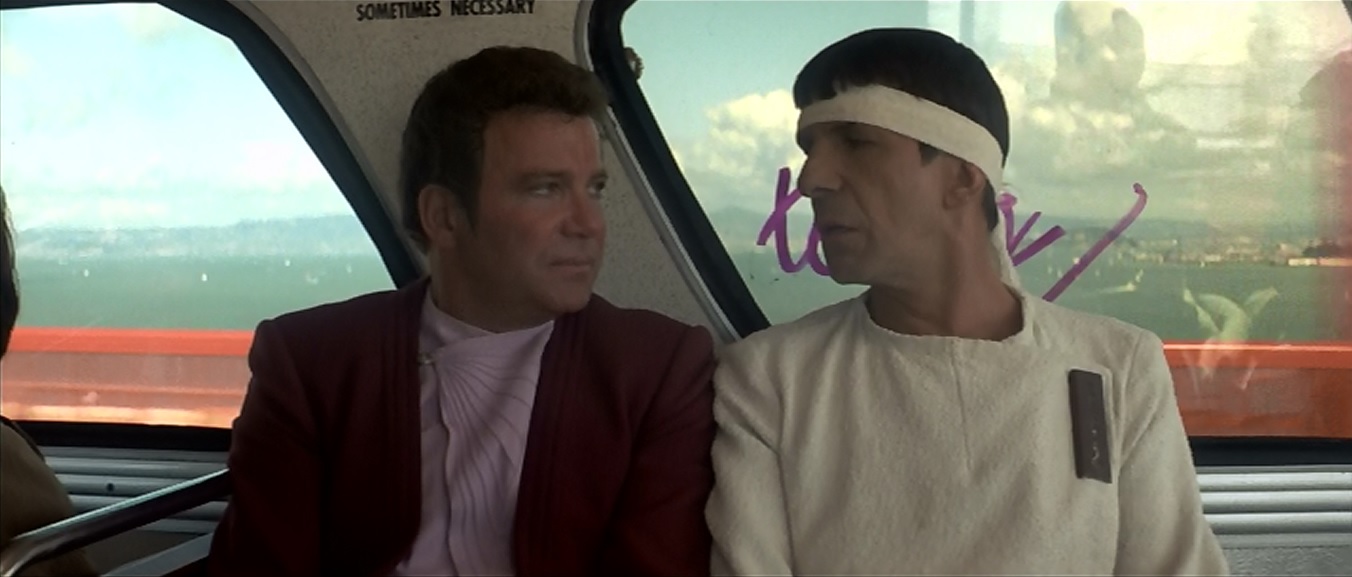
So... whales. It gets weirder, in the sense that this is the "Assigment: Earth/City on the Edge of Forever" episode, so... 'but good' is what I mean. That bespeckled joy I spoke about in the Original Series reviews is abundant in this film. Our gang of intrepids adjust to modern San Francisco life and jokes fly at their expense and at the expense of those unlucky enough to cross their path. And, of couse, they have to convince one person that they are who they say they are and get back home. No one considers warning everyone about the Eugenics Wars in the next decade.
Bottom line: is it good? Well, it isn't bad. The movie has no real villain (unless you count the Whaling Industry), only a problem that needs to be solved, and there isn't even much of a ticking clock element either. The obstacles only amount to people standing in their way, and one extended stretch where Chekov, the useless bastard, needs to be rescued. I'm okay with all that because it is well-written enough to keep me from getting angry, with people asking logical questions and reacting to the weird stuff like actual human fuckin beings. Good and good.
The weak side of it is just how goddamned strange it is, that it was made and that it took this route to smooth things over with the Klingons and return Kirk to Captain status in an identical Enterprise. It ties up loose ends even more than The Search for Spock tried to, and it weirds me out the more I think about it. I can't say that I'm not pissed about being reminded AGAIN that time travel is so easy, and the script certainly isn't interested in exploring the mechanics or the ramnifications of doing it, explaining everything away with a predestination paradox. And I can't say I'm not annoyed at all how they exaggerate the importance of the whales by reverting to pure propoganda. But... it's okay. I'm okay. It's fine, mostly. Yep. How are you?
6.0/10
Saturday, April 13, 2013
Review: Star Trek III: The Search for Spock (1984)
LAST TIME ON STAR TREK: The Crew did some courageous ass shit and Spock died. Some things blew up, a planet was created, and now the Enterprise heads home, in need of repairs. Yes, it's been like twenty minutes since the last one. Just like Back to the Future II or Quantum of Solace or The Two Towers! ... Uh oh...
Yes, the film you are about to watch is not going to be as good as The Wrath of Khan, the ultimate reason being: even though I have been screaming about "Balance of Terror" and when? this and when? that and whinewhinewhine, and then I was given that thing I so desired and expressed my joy at such a thing, the correct way to think is that they should never listen to me (the audience) and just tell me what to fuckin like. The Search for Spock gives the audience everything it ever asks for... and oh god... OH GOD NO MAKE IT STOP.
Okay so okay, outlying warriors from the Klingon Empire, led by Christopher Lloyd as the dopiest Klingon ever, gather some classified material on the Genesis planet. After killing the only other people who know about it, they make a beeline for the planet where Kirk's son and THEY RECAST SAAVIK?! THE FUCK? are busy encountering mysterious thingies. Meanwhile, the Enterprise crew, each member getting a quick needless close up and a pause for cheers, dock at an orbiting hub to butt heads with petty Starfleet personnel and young cadets who are young and brash and don't know nothin from nothin.
After a large amount of time-wasting exposition, a quick scene ripping off Star Wars, and more cutaways to the peripheral characters, we freewheel our way back onto the Enterprise (which can apparently be run by like 4 people without a problem) for a by-the-numbers showdown with the bad guy and the inevitable return of Leonard Nimoy who has now decided that he wants to be involved in the series, thanks, dick. Forget all that shit in the last film about the joy of youth -- it's great to be old! Forget the nonsense about the needs of the many -- Spock is more important and that makes it okay to break protocol!
After the heights it reached in The Wrath of Khan, it's an incredible letdown to be back in television show territory. It's got a similar spirit to The Motion Picture, but way more bland and time-wasty (yes, that's possible). Go ahead and imagine the first reel of the film burned to about twenty minutes in, and imagine the film entirely from the perspective of Saavik and Kirk's son, exploring the Genesis planet and coming across a newly formed Spock, maybe even battling some fringe Klingons who found out about the planet somehow. Now that's good television! But because it's a movie, you resign yourself to certain compromises. The Enterprise Crew has to be involved with the main line of action, however awkwardly, and we have to either utilize the things we establish or end them in this film.
It is here where you can say that at least The Search for Spock takes risks. We deal directly with the Genesis project instead of pretending it never happened a la "City on the Edge of Forever," but only to close the books on it because now it's unstable technology I guess. Kirk's son gets to have a good ol' time in a second movie, but gets fucking iced. The Enterprise gets blown up for real in a Corbomite bluff... er no, the opposite, it's like an Anti-Corbomite Gambit. Anyhow, all these risks seem pointless in the long run. A lot of attrition loss for something that could have been done a whole lot easier. Don't the transporters have a save state for Spock's body? Put Bones into the damn transporter, convince him somehow, I don't care. And what about the Giant Spock on that one planet? Did we forget about that?
And did we even need Spock's return in the first place? I know, I know, he's awesome and stuff, but he died. He's fucking dead. Deal with it. We had that shot of Spock's space coffin on the Genesis planet and that gave us hope and enough closure to move on. We did not need to bring him back in this nonsensical manner. And there was no explanation as to why Spock's new body wasn't unstable like the planet, right? Or why there wasn't some insane version of Khan running around the planet, fused with the fragments of the Reliant? Okay, that would have been awesome. Is it too late to call somebody?
I mean, look, I will say that the setups regarding a rapidly aging Spock, from child to man, are interesting, especially when viewed from the perspective of Saavik. "He was my superior last I knew him and now I'm going to have to fuck him, aren't I?" There are also some fun moments here and there, we get a larger window into Vulcan biology and we nail down Klingon culture. I don't hate the film... just everything that it stands for!
5.4/10
Tuesday, April 2, 2013
Review: Star Trek II: The Wrath of Khan (1982)
They took notes. Boy did they ever.
In some miracle flashbang of neuron fire, the powers that be behind Star Trek decide to try a different approach: instead of bringing the Enterprise crew back for yet more adventures, let's address the fact that their adventuring days are behind them and that their past mistakes might come back to haunt them. Not "let's do the show, but bigger," but "where would our characters be now?" What if Star Trek aged? And let's utilize that 'Space Seed' episode for the dangling participle of a villain we never killed, which is probably a better choice than using 'The Gamesters of Triskellion.' The result?
We are given -- nay, gifted -- a film that is one part treatise on old age, one part awesome fuckin space battle between two captains who have nothing left to offer one another but hardcore murder. It's a great feeling, finally getting what you ask for.
While investigating terraforming possibilities on what turns out to be the wrong damn planet, Terrell and Chekov run afoul of a very pissed off Khan (Chekov wasn't even in 'Space Seed', this is a bullshit thing) who uses mind control bugs to fool a bunch of people into giving him way too many resources for his insanity and thus begins the dangerous precedent of a film entirely about getting revenge on the Enterprise's captain, but fuckit! Suspenseful ass shit occurs in space and in a nebula and... well, that's it. But still!
During their conflict, the screenplay elegantly expands and contracts before us like a wave, keeping our minds busy between the action sequences. Khan is the macrotheme of a past mistake, forgotten and never checked up on, mirrored in the microtheme of Kirk's son. During the battle, many more bodies are added to the trail behind Kirk's forward march, including a relative of Scotty's (micro) and a MAJOR CHARACTER OKAY IT'S SPOCK (macro). We see that Kirk is less of a brilliant tactician but more of a miracle worker, able to utilize sheer velocity and cussedness to escape from an impossible scenario, or by outright cheating as their microtheme the Kobayashi Maru reflects. Mercy is dangerous in the wrong hands, a Starfleet Ship is too, and a device which promises the creation of a planet filled with life and resources. It addresses the price of things! How novel! And in a risky move that ultimately pays off, the screenwriters kill off a beloved character at the climax of their fun space adventure film and still manage a hopeful and uplifting ending.
It's full of miracles like this, really. The powers that be hired a guy who desperately wanted to make a submarine action film and then they stepped back and let him do his job. I'm convinced that Nicholas Meyer is some sort of unsung genius in this regard. He is what Metropolis was all about, the bridge between the head and the hands, bringing tactics to a brutal fistfight (or he could be Star Trek's Martin Campbell... he did do Time After Time). The camera is wonderfully involved in everything, and strikes that crucial balance between staying out of the way of the material and getting us right inside of it. The film moves when it needs to, but isn't afraid to take its time. They even took my suggestions for the last film and sped up a shuttle docking sequence into a much shorter, more powerful moment as the Enterprise lights come on one-by-one with a triumphant score FUCK YES
The Wrath of Khan deserves its status as an oft-mentioned Great Star Trek film, even if saying it's great is equivalent to saying Stairway to Heaven is great -- who's going to argue? NOBODY WORTH THEIR VAMPIRE SALT. I have nothing but good things to say about it... well, okay, maybe "How the hell did Chekov survive, exactly?" And this assertion that Kirk needs to command a ship falls flat in the face of the presence of "You are getting too old to succeed." And I guess the film does advocate tyranny of the majority... but hey, it also advocates execution! So... win/lose?
"There is no correct resolution. It's a test of character." See? Is that so hard to fuckin write, you hack bastards?
7.0/10
Sunday, March 17, 2013
Review: Star Trek: The Motion Picture (1979)
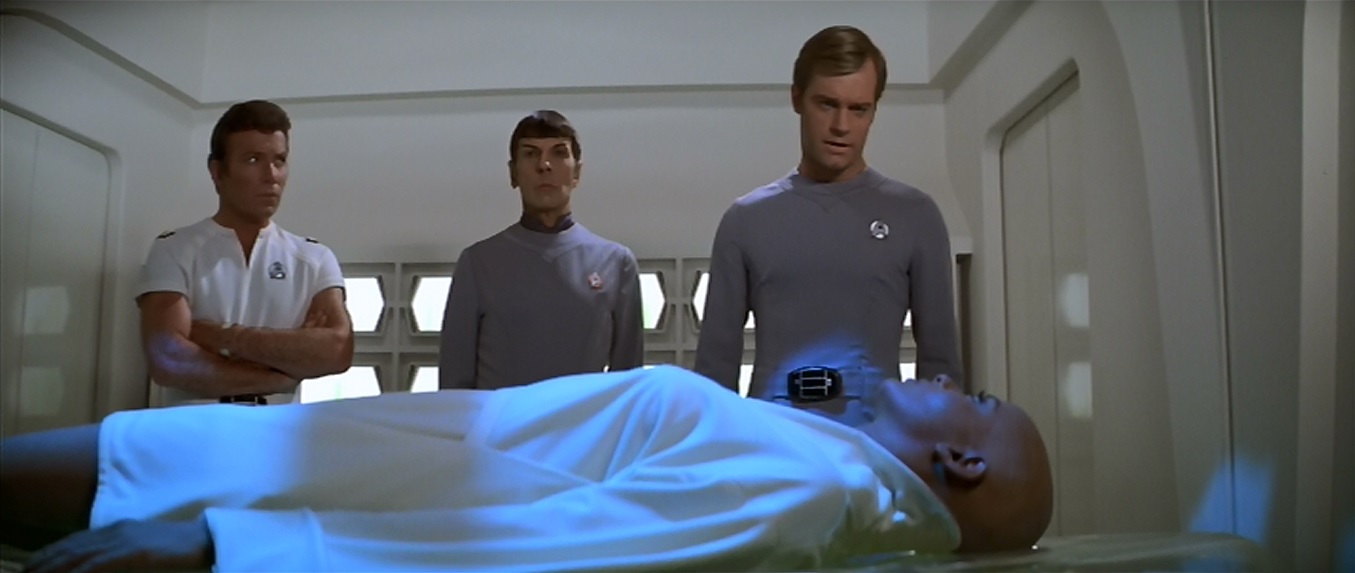
Three years after Captain Kirk last commanded the Enterprise (was it the time he changed into a woman or when everybody aged in reverse?), a Giant Thing heads towards Earth and, because he’s the best at destroying inexplicable clouds, Kirk is charged with getting the band back together for ONE LAST SCORE. Or several last scores -- are there more movies after this? Are there? Anyhow, we are treated to our beloved characters returning to a mostly white set amid flashy special effects and incredibly long fucking scenes, and yet… I find myself being surprisingly okay with most of the movie. Certainly not at the fact that Yeoman Rand did not age well, but the other stuff.
Now LET ME FINISH I know that this film has a bit of a reputation of being a dull, deliberately paced snore-fest that serves only to showcase its special effects and cash in a bit on 2001’s procedural style. I suppose that assessment is fair. In true hard sci-fi fashion, certain scenes exist only to convey a theme, synthesize a mood, or build a believable world.
In this way, great moments almost emerge. An example: Kirk has a two-minute long admiration of the Enterprise in the repair dock, and it would be magnificent if it were properly built up from brief flashes of its hull through thick repair scaffolds to the clear image of Kirk staring proudly at the bow as Goldsmith's overbearing space adventure score goes BUM BUM BUUUUUUUUUM! Instead, we see every second clearly, and they keep it going, showing us the entire docking procedure. An emotional reaction is less important than knowing the cold, hard facts, and we are robbed of a potentially greater experience.
And yes, scenes like this, scenes that exist for their own sake and dangle outside of the main story, keep happening. We see the dangers of transporter travel and warp speed travel; we see mission briefs conveying information to the crew that we, the audience, don't require in such a labored manner; we see scenes of rehabilitation between the young dude and his hot, bald exgirlfriend walking around the Enterprise. The other operating motive is that these scenes exist as a platform for state-of-the-art special effects, any chance they can muster; a macro example is Spock’s endless, tension-bereft spacewalk into V-Ger, a micro is Bones and Kirk talking in front of the galaxy’s most distracting window.
The plot is one suited for an episode of the television show -- in fact, incredibly close to "Where No Man Has Gone Before" or "The Lights of Zetar," merged with "The Changeling." Kirk’s rough and tumble Captaining is frowned upon but tolerated, two peripheral characters are in love and one of them is some kinda headmakeydo, everybody has to work together to solve a problem, Chekov says some shit… basically, we’ve seen it all before and without the added steps of reintroducing the crew. It is a compact story in a container that is too large, lacking the content to justify how slow it is, wheeling towards the one guy stepping onboard the weird spaceship to have himself an adventure he couldn’t find on the Enterprise for some reason… basically like Close Encounters of the Third Kind but with a bald hotty. Okay, so maybe I get it.
However, using the 2001 argument in a dismissive manner is a mistake, and treating it like the end-all-be-all flaw that kills the film is something I take issue with. That sensibility is truly what the old show could have used in greater degree, to break apart all of the scenes with the giant cats and the Earth parallels. We, after all, had plenty of the bottom-up emotional stuff, more than our fill, and very rarely were we engaged in a top-down futuristic world that didn't fall apart under slight scrutiny. In that situation, a kite was flying across the sky and well out of our reach. Here, someone has grasped the string and has pulled it down to our height. We definitely need to let it soar higher, but for now, at least we have control of the kite.
I submit with the above that The Motion Picture is in fact what you would want out of a movie based on the television show… not "exactly," but "ehhh close I guess." Without the stylistic choice, the movie does retain the spirit of exploration, as well as the less flattering aspects of this universe under Federation perspective. People die left and right like it ain’t no fuckin thing, a bunch under the murderous expanse of a sinister cloud, what is finally determined to be the DIRECT FAULT of Earth, and nothing within the film appears to come of it. Accountability and consequence are feh... just like the show!
Perhaps I'd have a hard time recommending this to someone who doesn't already like Star Trek, or to... y'know... girls. I was certainly shocked by how into it I got. Like an alien creature bent on your destruction, it is an ordeal and yet… fascinating to study. V-Ger help me, I like it a little, but it’s no "Balance of Terror" HAHA GOT IT IN THERE.
6.1/10
Thursday, November 22, 2012
Review: The Limey (1999)
We’re stabbing into the heart of Soderbergh, lover of film and mainly of Point Blank, and later, ceilings. Similar to his last film, we have a simple story told in a non-linear fashion with a strong emotional core: a familial blood bond between a father and his freshly corpsened daughter. Also like Soderbergh’s last film, the story isn’t as complex as its characters’ motivations and responses.
Terrence Stamp, fresh out the slammer, decides to investigate the circumstances around his daughter’s abrupt death. What he finds is pretty much what he first figured and NO ONE… except for Luis Guzman… is safe from his wrath!
He must have realized he cracked some sort of code with Out of Sight, either before or during the production of The Limey, that prompted Soderbergh to run strongly in the direction of mirroring the main character’s state of mind through the stylistic choices. Think what Woody Allen did with jump-cuts in Deconstructing Harry, here with staging and brief glimpses of later scenes peppered under Terrence Stamp’s narration. The same conversation is filmed in three separate locations and edited together, a sudden dream sequence imagines a violent scenario four different ways, and the final shot of the film is placed at the beginning. It is the very definition of context -- a man is attempting to order his life, and the moment it makes sense to him, it makes sense to us.
Soderbergh pulls out stops in other areas, mainly in casting; a bunch of up-starters from the 60’s spiritually reprising their roles from Poor Cow, Easy Rider, Vanishing Point, whathaveyou. A theme of lost innocence from the 60’s is probably Soderbergh’s addition to the screenplay and coincides with his tribute to films of a bygone era.
Now, all of this is swirling around a story that is of the barest of bones. There is lengthy speech on Stamp’s daughter and their relationship, but much less about Valentine’s drug deal that incited it, the DEA’s involvement, and just how the hell Stacy and Kim fit into all of it. You can break the film down into four key scenes of action and the rest is window dressing. The climax is a siege on the villains’ stronghold… done from the villains’ perspective. Violence is brief, simple, and somehow far from visceral. Satisfaction comes from the theme. It does not come from the plot, nor the revenge itself.
There is so much to mull over regarding the film’s presentation, I don’t think it would have worked without the choices made by the director. Dobbs, the screenwriter, has gone on record (literally, the commentary) to say that film’s failing aren’t his, that vital scenes were cut out in favor of constructing the atmosphere The Limey currently enjoys. Dobbs fails to cite more than one example, and considering his next project with Soderbergh over a decade later, I think he needs to reevaluate his position. Perhaps Soderbergh has even saved it.
6.9/10
Thursday, August 2, 2012
Review: Out of Sight (1998)

George Clooney breaks into films (not quite banks) and Soderbergh wreaks some good-natured fun with zany criminal activity, the criminals and cops played by a slew of recognizable A-Listers including the up-for-anything Luis Guzman. Jennifer Lopez plays the tough broad assigned to solve the case and catch Clooney… in more ways than one OHHHHHHHHHHHHHHHHH… hhhhhHHHHHHHHH so what I mean is, she gets weirdly into him after getting strongarmed into a trunk and grinding into his crotch for a long drive. Girls like it when you take a hard hand. Buuuut it ends up being pretty plausible and we as an audience hope that they get to fuck… for some reason…
The love story between them two is the real center of the film, the strong emotional core. Its stages of development are set between Clooney’s narrow escapes and Lopez’s dogged pursuits. It eventually becomes the fuel for the climax, and works better than one might think, perhaps because the diamond heist itself is not the focus, and as such, not as complex. Neither the story itself.
Since he cannot resist with the ballsy experimentation, Soderbergh goes for a minimalist crime-comedy without attempting to hide the minimalism, in a sense pulling out all of the stops by keeping them all in. Scenes are filmed in simple ways and staged in straightforward manners in natural locations or clearly built sets while he conjures naturalistic performances out of a television actor and a musician. It’s almost Sex, Lies and Videotape, with warmer lighting schemes. And there is, of course, the non-linear storytelling aspect.
Out in 1998, this film is another gift from Tarantino’s meteoric rise, and it’s a good one that succeeds where Soderbergh’s own Underneath failed. And in perhaps a unique occurrence that is doubtful to be repeated, it has a strong tie in continuity to Jackie Brown (also based on an Elmore Leonard novel) by way of Michael Keaton returning briefly as Ray Nicolette. One could argue that Samuel Jackson’s cameo as Hejira Henry ruins that tie SO WHAT DON’T YOU RUIN THIS FOR ME!
Out of Sight does well mixing likable criminals with the unlikable ones, weaving it into the framework of the love story, and finding the time for a theme; in a wild west mentality, there are levels of honor associated with your work, but otherwise men and women, cop and criminal, under no uncertain terms, are the same. How do you make that fun? This way I spose. However, for non-linear storytelling with a criminal angle, you know what the Rosetta Stone still is.
6.6/10
Saturday, June 16, 2012
Review: Star Trek (1973-1974) [17-22]
"The Pirates of Orion" (3/10)
I can’t help but think they are mispronouncing the name throughout the entire episode, like Oreo with an “on” sound at the end. That must cause some confusion when it’s written down in Starfleet reports.
--A combination of a terminal disease episode and a “Balance of Terror” style showdown, which you’d think would write itself. Close, but no, not quite. It’s another suitable story for a live-action counterpart, complete with awkward fight scene.
"Bem" (3/10)
A petty bureaucrat observes the Enterprise crew in a survey mission while at the same time sabotaging it. Things get WHAT THE almost immediately when he disassembles himself. Weird moment in cages.
--It at least have a couple of things going for it, like the Kirk/Bem political arguments and things like: after getting captured twice, Kirk says, “There are times, Mr. Spock, when I think I should have been a librarian.” A pretty good line so maybe AW BALLS ALL POWERFUL MEDIATOR FUCK!
"The Practical Joker" (4/10)
“Captain, an unidentified energy field-” AAARGH! RUN! FUCKING RUN YOU MORONS!
--Like a spattering of other episodes I don't feel like going back and looking up, it has a complete script and a compelling story idea with the ship computer getting infected by a joke-virus and- whoa whoa whoa, wait a minute… The Enterprise has a holodeck?! That’s it, I’m outta here.
"Albatross" (3/10)
Spock in command position finally gets a win.
--I didn’t realize that they hadn’t done a trial episode yet, although it eventually becomes less about proving Bones’s innocence and more about finding a cure for the plague set upon them. It’s almost less-bad, just suffers from plodding along without many interesting things happening.
"How Sharper Than a Serpent’s Tooth" (4/10)
They battle a Mayan god, KukulKAAAN! Seriously, more gods have come to Earth and caused a ruckus than... somewhere else where that has happened a lot. Then they pick a spot in space to take up residence until we stumble across them? I don't fucking buy it.
--We are introduced to the character Walking Bear, an Injun who happens to have the information needed to advance the plot. Where do you place him? At navigation, replacing the off-putting Ensign Erix who has weird skin and four legs? Or do you replace the beloved Sulu? Guess what they chose to do. Can that guy ever escape getting shafted? Maybe he doesn't want to OHHHHHHHHHH. They spring a sudden Galactic Zoo on you, but then diverge into philosophical territory. Ridiculous plot, good execution. By comparison, of course.
"The Counter-Clock Incident" (4/10)
The Enterprise runs into some Benjamin Button shit. Overuse of the word “universe.”
--They mess around with Starfleet history here, but my knowledge of it isn’t so good so I don’t know if having old Enterprise crew members is a contradiction. It certainly isn’t in line with the Abrams film but what the hell does that mean. Anyhow, the Crew ages in reverse at varying speeds, depending on the story requirements, Spock gets jobbed out of a command position and because we can’t very well leave our main characters as children, there’s a weird fix with the transporter similar to the one in “The Terratin Incident.” How funny that both Incidents do that. I guess I’m done now? Thank GOD.